No silver bullet, no shortcut to wisdom
Humans have always outsourced judgment. We watched whoever seemed to know, copied what worked, and moved on with life. At some point, capitalism attached an invoice to it.
Engineers are also humans, and they found out that copying and pasting from StackOverflow yielded generally good results. They shared best practices with each other and depended on each other’s work, often adding open source libraries to their projects without really looking at the source code.
Software scaled the way it did as we built trust mechanisms to leverage each other’s knowledge and work. We created registries, stars, test suites, CVE databases, and we assumed that the thousand eyeballs someone else is providing were a good enough proxy to infer reputation from unknown sources.
We got so used to these mechanisms that we forgot they are made of trust, until an npm supply chain attack shows up in the build and reminds everyone what we were leaning on all along. Truth is, even the thousand eyeballs will soon be gone: nobody is looking at the code, we are lazy and we don’t have to do it anymore.
Here is the part I want to defend: the laziness itself is fine. More than fine, it is a human trait, and it has led us to many engineering achievements. Larry Wall named it one of the three virtues of great programmers. In fact, the whole engineering practice is organized laziness as we refuse to solve the same problem twice.
Laziness is a means to an end, and the end is what determines vice or virtue. Pointed at growth, it is a weapon for efficiency and effectiveness, for staying truth seeking and fully owning the outcome.
When laziness is aimed at optics or appearances, it becomes plain corporate alpinism, where people are climbing to be seen climbing and effort is spent more on looking right than being right.
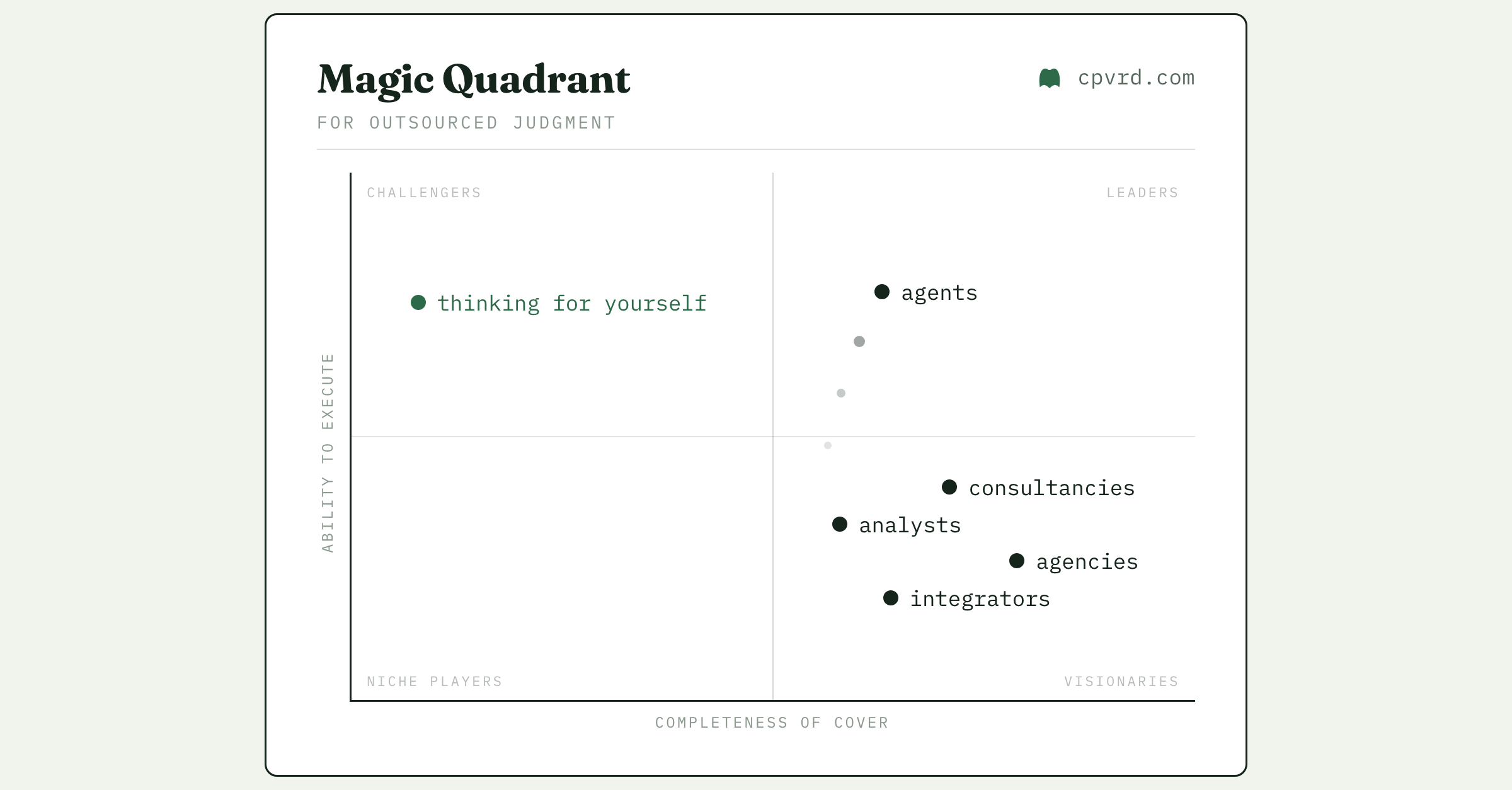
And when those optics are the local optimum, looking right gets a companion and CYA (cover your ass) becomes the norm and a market of its own. Thinking was outsourced to analysts, strategy to consultancies, vendor management to integrators. Cover sold as expertise, that’s a product.
Last week, Gartner published its 2026 Magic Quadrant for AI-Augmented Code Modernization Tools with AWS above Anthropic and OpenAI not on the chart at all. The loudest voices in engineering pointed and laughed, AWS posted a proud thread about its own ranking, and the models kept writing more of the world’s code either way.
Laugh all you want, but somebody pays for that report and they will keep paying, because the report is the packaging and the product is somebody else’s throat to choke.
Before the engineers reading this feel superior: vibe coding is our own version of Gartner-oriented management. Shipping code you never read (and without proper guardrails) is buying the Quadrant with a keyboard.
We have been there before, though. Assembly was abstracted away by high-level languages, manual memory management became garbage collection, and each abstraction took a slice of control with it: the compiler decides what your code becomes, the garbage collector decides when your objects die. Vibe coding is taking the next slice, the code itself, with a twist the others never had. This one is not even deterministic.
Those slices all sat on the accidental side of the craft, the part Fred Brooks said tools can eat. The essential part, he promised in 1986, would never fall to a silver bullet. Vibe coding is redrawing his line, making most of the code itself accidental. And the essence moved up, to judgment.
GenAI is industrializing the old trade, cover sold as expertise, now well beyond software, but this time there is no clear throat to choke yet. Agents have no names and nothing to lose, but humans have something to lose if they don’t use agents, so industrialization continues.
Now, expect the industry changes to be very fast and very slow at the same time. The mavericks and early adopters are churning models, processes and organizational structures by the day while the laggards, the monopolists, and the high-moat players will take years to really move.
Let me be specific on how: the mavericks usually have the most expertise, so they need the trust mechanisms the least. As adoption spreads, the mechanisms get built behind them, registries and rankings and audits for agents, to carry everyone else through the same transformation.
Notice it is all one story: our laziness outsources the judgment, we build trust mechanisms so we can lean on each other, and somebody packages the cover and sells it back to us. GenAI did not invent any of this, it is industrializing all of it at once, right as judgment becomes the essence of the work.
So, where do you place your own trust in the meantime? Are you a maven or a late adopter?
Our brains defer trust to our gut, to our instincts. If you want to be early (and you should), there is no way to calibrate your gut without seeing the transformation hands-on.
The reports will clearly not do it and the rankings will not either. So if you do not want to wait for the industry to settle: gear up, experiment, read, and be curious. You will find out that there is no shortcut to wisdom and a calibrated gut.
The whole trade is self-service now. You can outsource the judgment, but you are the one making the final call.
