Zero-Based Doctrine
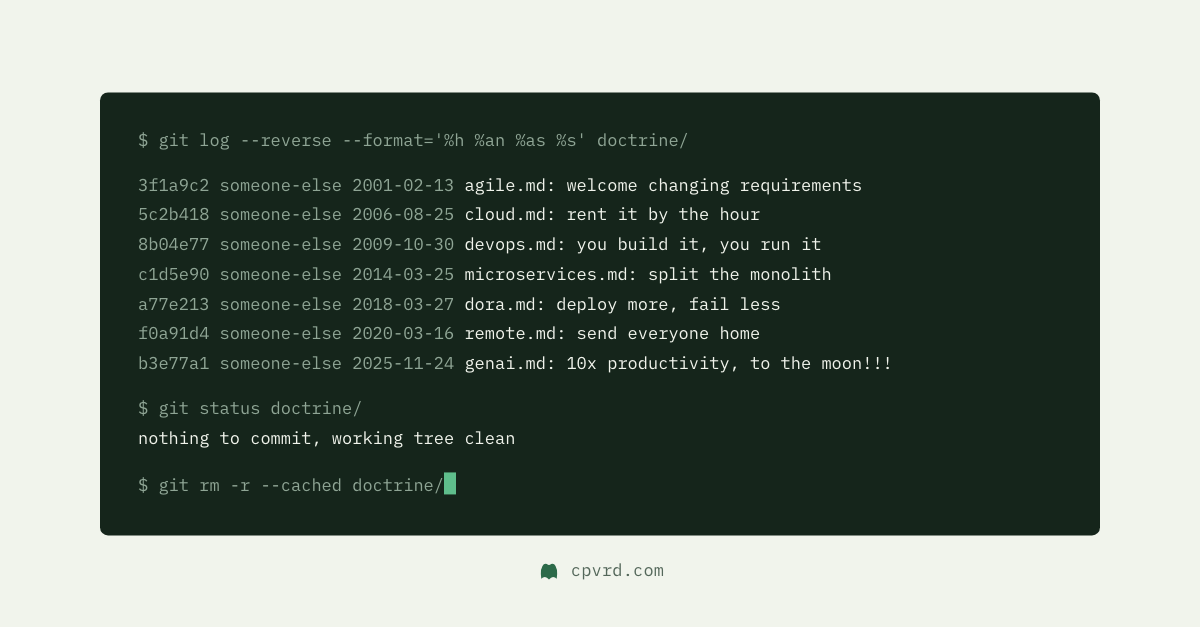
In 1969 an accountant at Texas Instruments went looking for waste and found something worse: inertia deciding how the company ran. Peter Pyhrr’s fix was zero-based budgeting. Every cycle, the budget starts from zero and every expense earns its way back in, whatever last year said.
For everything beyond money, the answer is usually incremental evolution, but a deeper review is required when the playing field tilts.
Right now, many companies are looking at the AI transformation and have started a series of process improvements. But what about the company’s set of beliefs, goals, working agreements, and everything else that originates the processes?
The systems thinker Donella Meadows would call that layer the paradigm, the deepest practical place to intervene in a system, and I endorse intervening in a more grounded manner: give it the Pyhrr treatment.
How did the Agile Manifesto come to be? Seventeen practitioners met at a ski lodge in Utah after spending years inside real companies running lightweight methods that worked, under different names. Over a weekend, they uncovered and distilled the principles they were already living and wrote them down. Extracted from practice, backed by the trenches: the foundational stone of a new doctrine.
There was no improving waterfall into agile. Better DevOps is still DevOps. Some companies are AI-adopters, some are AI-first and some are AI-native. Huge difference.
Every few months a step change in the models resets what the tools can do, and the tools reset the ways of working built on top of them. Until that settles, nobody can claim a best practice as lasting. The next manifesto comes later, extracted from practice like the first one.
So what can you do before the puck stops moving?
Lead with vision. Read the movement. The next moves do not need the destination.
For larger organizations, identifying the areas most likely to change is already progress. Starting the evolution, moving from “run the bank” to “change the bank”, is progress too, and definitely not enough.
And this is the whole point: audit your own doctrine, one premise at a time. Starting clean, with the tools that exist today, would we still choose this? Some premises will survive. A few will turn out to be last decade’s budget, renewed every year without a conscious decision being made by anybody.
I have my own set of bold predictions that I am keeping warm for a future post. For now, the work is simpler: understand your practices, when each was last chosen, and why. That awareness is what gives you the right to change the paradigm instead of being trapped inside it.
